
Evernorth Chief Business Officer Sagar Shah has pushed back on the idea that Ripple’s dollar-backed stablecoin RLUSD could replace XRP, arguing that the two assets are designed for different roles in on-chain finance. In a May 20 blog post, Shah said RLUSD can serve as a high-quality digital dollar, while XRP remains the neutral routing asset for cross-asset settlement, liquidity and collateral on the XRP Ledger.
The argument addresses a recurring question in the XRP community and among market observers: if RLUSD can move dollars on-chain and settle quickly, what function is still left for XRP?
Shah’s answer is that RLUSD and XRP are not competing for the same job. RLUSD, he wrote, represents a dollar leg in transactions. XRP is the asset that can sit between markets when two parties do not naturally want to trade the same asset pair.
Will RLUSD Replace XRP?
To explain the distinction, Shah used a playground trading analogy in which children try to swap snacks at recess. Direct trading becomes inefficient when one child has Goldfish, another has fruit snacks, and the person with fruit snacks wants pretzels instead of Goldfish. As the number of snacks grows, the number of possible trading pairs expands rapidly. With ten different snacks, Shah noted, there are 45 possible pairs. With 100 snacks, there are nearly 5,000.
That, he argued, mirrors the problem faced by real markets as tokenized assets proliferate.
“The chance that two specific kids happen to want each other’s exact snack at the exact same moment gets smaller and smaller,” Shah wrote. “This is the same problem real markets have. The more assets there are, the harder direct trading becomes.”
In the analogy, the solution is “the swap kid,” a participant who holds a little bit of every snack and allows everyone else to trade through him. Shah said this is the role XRP plays on the XRP Ledger. A trader may see a simple swap from a tokenized Treasury bill into a euro stablecoin, but the actual route could be tokenized Treasury bill to XRP to euro stablecoin.
“The XRP step is invisible to the trader,” Shah wrote. “They see ‘Treasury bill in, euro stablecoin out.’ But the XRP in the middle is what makes the trade possible, instantly, without anybody having to find a specific buyer on the other side.”
Shah framed RLUSD as “something entirely different.” It is a stablecoin, designed to be valued at $1 and backed by reserves held by its issuer. That makes it useful when one side of a trade wants a digital dollar. But it does not make RLUSD a universal routing asset across the ledger, he argued.
“RLUSD isn’t trying to be the swap kid,” Shah wrote. “It’s trying to be a juice box — a specific thing, with a known value, useful whenever both sides of a trade want a dollar.”
The distinction matters most in markets where there is no natural dollar leg. Shah cited examples such as tokenized Treasuries being swapped for tokenized euro money market funds, lending markets denominated in different assets, and other cross-asset activity that does not begin or end with dollars. In those cases, he said, the ledger needs a neutral bridge asset in the middle.
Three Reasons Why RLUSD Is Not An XRP Killer
Shah gave three reasons why he believes RLUSD cannot serve that function. The first is issuer risk. RLUSD exists because a company mints it and holds dollars in reserve. That is standard for stablecoins, but Shah argued it becomes a structural weakness if the stablecoin becomes the mandatory routing asset for all trades.
“If any stablecoin issuer ever ran into trouble — a regulatory issue, a banking issue, a court order to freeze accounts, a problem with their license — the stablecoin could have a problem too,” he wrote, adding that this was a general point about issued stablecoins rather than a claim about any specific issuer. “That’s fine if the stablecoin is one asset among many. It’s a serious design flaw if the stablecoin is the asset every trade routes through.”
The second issue is neutrality. Stablecoin issuers must comply with sanctions, court orders, blacklists and geographic restrictions. Shah said those controls are appropriate for a regulated stablecoin, but problematic if the same token is expected to route trades across a global permissionless ledger.
“The router has to work for everybody across jurisdictions and counterparties, without an intermediary who can decide who’s allowed to trade,” Shah wrote. “Under the current protocol design, no party can freeze XRP or prevent it from settling a trade. That neutrality is a structural requirement for the routing role.”
The third point is market structure. Liquidity pools and automated market makers require two different assets. There can be pools between RLUSD and euro stablecoins, or RLUSD and tokenized Treasuries. But Shah argued the broader question is which non-RLUSD asset becomes the common bridge across the ledger. In Evernorth’s view, that asset is XRP.
“In a world with hundreds of tokenized assets, every pair can’t have its own pool,” he wrote. “There isn’t enough capital or enough market-maker attention. A few assets end up doing most of the bridging work.”
Shah said XRP is positioned for that role because it is among the most liquid assets on the XRP Ledger across a wide range of other assets, because the protocol’s pathfinding routes through it by default, and because market makers concentrate capital on XRP pairs where volume exists. He also pointed to XRP’s lack of issuer, resistance to censorship under the current protocol design, and years of uninterrupted operation as relevant attributes for a bridge asset.
The post also extended the argument beyond trading. Shah said XRP can function as collateral in on-chain lending because it is liquid, broadly accepted and not subject to an issuer that can interfere with the asset during the life of a loan. He also highlighted escrow, where XRP can be locked for release at a future time or upon certain conditions, with the ledger enforcing the rules.
For Evernorth, the broader thesis is that on-chain finance will need both a digital dollar and a routing asset as more assets move on-chain. Shah was careful to frame that as a forward-looking view subject to uncertainty, but said the roles remain separate.
“We’re not making the case that RLUSD is unimportant,” he wrote. “The growth of on-chain finance requires a high-quality digital dollar, and RLUSD is designed to be one. We hold a view that the dollar leg and the routing leg are two different functions, and both grow with the size of the system.”
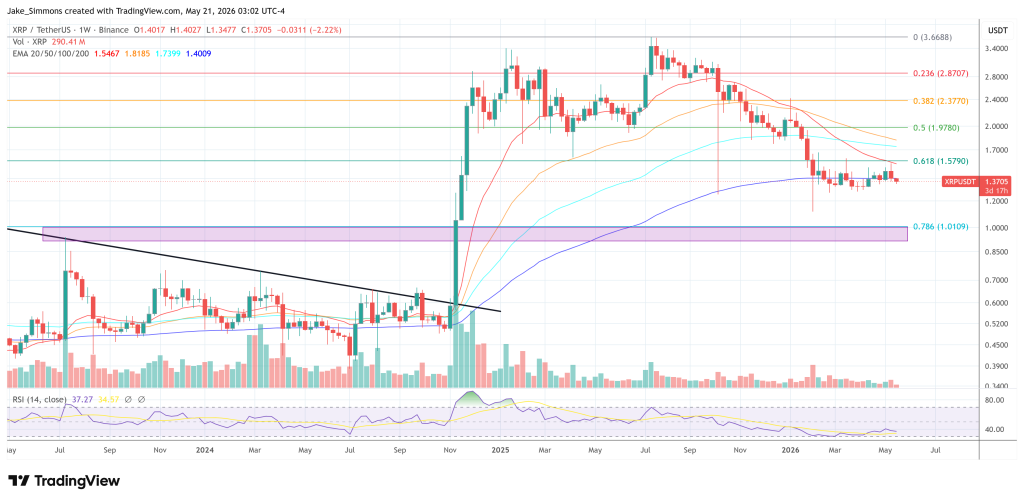
At press time, XRP traded at $1.37.

You can get bonuses upto $100 FREE BONUS when you:
💰 Install these recommended apps:
💲 SocialGood - 100% Crypto Back on Everyday Shopping
💲 xPortal - The DeFi For The Next Billion
💲 CryptoTab Browser - Lightweight, fast, and ready to mine!
💰 Register on these recommended exchanges:
🟡 Binance🟡 Bitfinex🟡 Bitmart🟡 Bittrex🟡 Bitget
🟡 CoinEx🟡 Crypto.com🟡 Gate.io🟡 Huobi🟡 Kucoin.













Comments